
This article needs maintenance and organization, as it may have become cluttered or confusing. Its heart is in a good place, it's just a little special. Won't you please help out an article in need? This template will categorize articles that include it into the Clean Up task category.
 This page uses content from Wikipedia. The original article was at Comics Code Authority. The list of authors can be seen in the page history. The text of Wikipedia is available under the Creative Commons Attribution-ShareAlike 3.0 Unported License.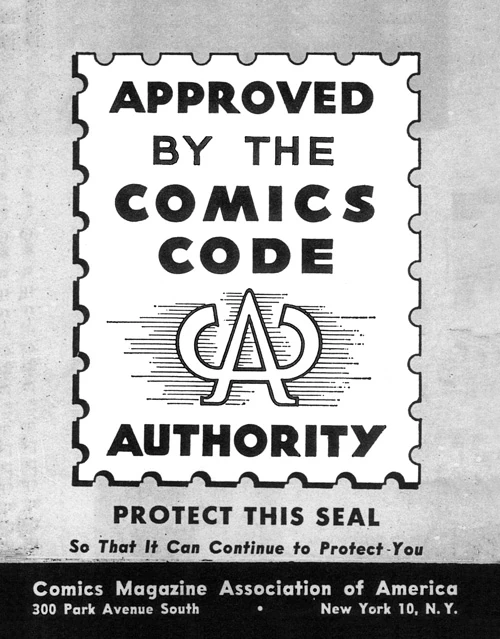
The Comics Code Authority (CCA) is part of the Comics Magazine Association of America (CMAA), and was created to regulate the content of comic books in the United States. Member publishers submit comic books to the CCA, which screens them for conformance to its Comics Code, and authorizes the use of their seal on the cover if the books comply. At the height of its influence, it was a de facto censor for the U.S. comic book industry.
The seal began appearing on DC Comics covers in March, 1955.
History
Creation
The CCA was created in 1954 as part of the CMAA in response to public concern about what was deemed inappropriate material in many comic books. This included graphic depictions of violence and gore in crime and horror comics, as well as the sexual innuendo of what aficionados refer to as "good girl art". Dr. Fredric Wertham's book "Seduction of the Innocent" rallied opposition to this type of material in comics, arguing that it was harmful to the children, who made up the majority of the comic book audience. Senate subcommittee hearings led by Estes Kefauver had many publishers concerned about government regulation, prompting them to form a self-regulatory body instead.
Like previous codes, the CCA prohibited the presentation of "policemen, judges, government officials, and respected institutions ... in such a way as to create disrespect for established authority." But it added the requirements that "in every instance good shall triumph over evil" and discouraged "instances of law enforcement officers dying as a result of a criminal's activities." Specific restrictions were placed on the portrayal of "kidnapping" and "concealed weapons".
Depictions of "excessive violence" were forbidden, as were "lurid, unsavory, gruesome illustrations." Vampires, werewolves, ghouls and zombies could not be portrayed. In addition, comics could not use the words "horror" or "terror" in their titles. The use of the word "crime" was subject to numerous restrictions.
Where the previous code had condemned the publication of "sexy, wanton comics," the CCA was much more precise: depictions of "sex perversion", "sexual abnormalities", and "illicit sex relations" as well as "seduction", "rape", "sadism", and "masochism" were specifically forbidden. Love stories were enjoined to emphasize the "sanctity of marriage" and those portraying scenes of passion were advised to avoid stimulating "lower and baser emotions."
Advertisements for liquor, tobacco, knives, fireworks, nude pin-ups, postcards, and "toiletry products of questionable nature" were all prohibited.
Early Criticism and Enforcement
The CCA had no legal authority over publishers, but magazine distributors often refused to carry comics without the CCA's seal of approval. Some publishers thrived under these restrictions, others adapted by canceling titles and focusing on Code-approved content, and others went out of business.
Publisher William Gaines believed that clauses forbidding the words "crime", "horror" and "terror" in comic book titles had been deliberately aimed at his own best-selling titles "Crime SuspenStories", "The Vault of Horror" and "The Crypt of Terror." These restrictions, as well as those banning vampires, werewolves and zombies, helped make his company, EC Comics, unprofitable; all of its titles except MAD were cancelled in the year following the CCA's introduction.
Fredric Wertham dismissed the Code as an inadequate half-measure.
Modern Adherence
Influence of the CCA mostly diminished from the 70's to the 90's. The logo has gone from a large icon, meant to indicate to parents that the book was okay for their kids, to almost a small footnote on the cover. As of 2007, DC Comics and Archie Comics were the only two major comics publishing companies to continue submitting stories to them for approval. However, DC only submitted stories from the Johnny DC and DC Universe lines, and even still occasionally published unapproved stories regardless. In 2011, the Code ceased to exist as Archie and DC pulled out of it early that year.
The Code
1954
The 1954 code stated the following:
- Crimes shall never be presented in such a way as to create sympathy for the criminal, to promote distrust of the forces of law and justice, or to inspire others with a desire to imitate criminals.
- If crime is depicted it shall be as a sordid and unpleasant activity.
- Criminals shall not be presented so as to be rendered glamorous or to occupy a position which creates a desire for emulation.
- In every instance good shall triumph over evil and the criminal punished for his misdeeds.
- Scenes of excessive violence shall be prohibited. Scenes of brutal torture, excessive and unnecessary knife and gunplay, physical agony, gory and gruesome crime shall be eliminated.
- No comic magazine shall use the word horror or terror in its title.
- All scenes of horror, excessive bloodshed, gory or gruesome crimes, depravity, lust, sadism, masochism shall not be permitted.
- All lurid, unsavory, gruesome illustrations shall be eliminated.
- Inclusion of stories dealing with evil shall be used or shall be published only where the intent is to illustrate a moral issue and in no case shall evil be presented alluringly, nor so as to injure the sensibilities of the reader.
- Scenes dealing with, or instruments associated with walking dead, torture, vampires and vampirism, ghouls, cannibalism, and werewolfism are prohibited.
- Profanity, obscenity, smut, vulgarity, or words or symbols which have acquired undesirable meanings are forbidden.
- Nudity in any form is prohibited, as is indecent or undue exposure.
- Suggestive and salacious illustration or suggestive posture is unacceptable.
- Females shall be drawn realistically without exaggeration of any physical qualities.
- Illicit sex relations are neither to be hinted at nor portrayed. Violent love scenes as well as sexual abnormalities are unacceptable.
- Seduction and rape shall never be shown or suggested.
- Sex perversion or any inference to same is strictly forbidden.
- Nudity with meretricious purpose and salacious postures shall not be permitted in the advertising of any product; clothed figures shall never be presented in such a way as to be offensive or contrary to good taste or morals.
Updates Since
- The Code was revised in 1971 to permit the depiction of "narcotics or drug addiction" if presented "as a vicious habit".
- Also, newly allowed were "vampires, ghouls and werewolves... when handled in the classic tradition such as Frankenstein, Dracula, and other high caliber literary works written by Edgar Allan Poe, Saki, Conan Doyle and other respected authors whose works are read in schools around the world". Zombies, lacking the requisite "literary" background, remained taboo.
- The ban on references to Homosexuality was repealed in 1989 to allow non-stereotypical portrayals of LGBT characters.